Lesser know but popular local temples

A Sunday morning drive to the Harsiddi Mata Mandir in Rangir near Sagar turned out to be a trip back in time. En route to the temple we crossed a small check dam which had a very tempting pool of water, with children splashing about.


The scene is utterly rural with rolling fields and trees in full bloom with summer semal flowers.


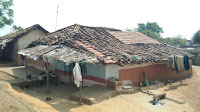
The smooth road passes through quaint villages with old styled terracotta tiles (Chappar) roofs and mud walls. 


Women draw water at hand pumps and children, dogs and cattle loll about in the heat. Less cellphone towers and dish antennas, it could be 19th century India.


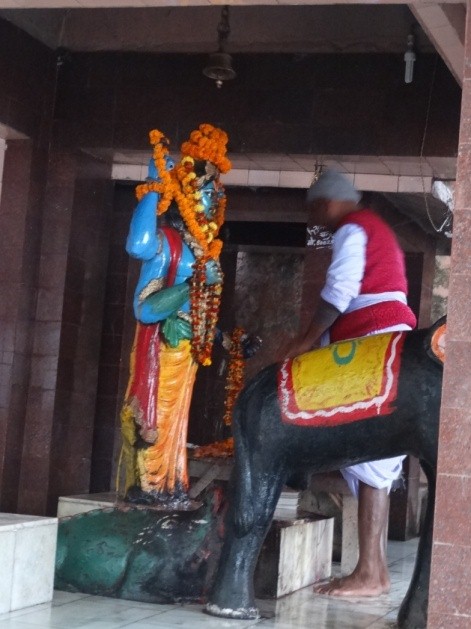
The Har Siddi Mata temple is a huge complex which has grown around the small central structure housing the idol of the deity. It is a ecosystem in itself with shops selling  puja items, juice vendors, juice and fruits. Inside, pujaris sit beneath brightly painted walls which advertise rates for conducting marriages and mundans.


Occasional children walk up asking for a rupee. Many are seen loitering around playing cricket or playing the drums at the temple entrance. 


There are posters announcing upcoming pujas, prayer gatherings and Government schemes. The whole place is quite serene and calm and well worth a visit.   


Varansai was always a destination I wanted to visit with family.  Around 400kms from Patna via Bodh Gaya, and considering the roads till we came to the highway it would take us about seven-eight hours. We left early though not really early. It took us four hours to reach the highway. We decided to first go to  Allahabad and then return via Varanasi. The highway was smooth and the drive was enjoyable though all through Bihar there was no decent place to stop for a bite. It was almost night by the time we reached Allahabad. Hungry and tired, we decided to put our trust in the AL Chino café, recommended by Lonely Planet. Thankfully it lived up to its billing and we had a varied and hearty dinner to round off our long day.

The next day we visited the Sangam, one of the holiest sites in India. The sight of the calm river was a delight with the Allahabad Fort as an imposing backdrop. As the boat was rowed slowly, we enjoyed every minute of the ‘chappu’ boat with the new bridge on the river in the background. We slowly crossed the green waters of the Yamuna and approached the Sangam where it merged with the brown waters of the Ganga. It amazed us to see such a clear demarcation of colour in the water. There were quite a few sea gulls too, merrily accepting food from the pilgrims. In fact there were boatmen selling bird food. Sad!


Our boat stood still at the Sangam and we just enjoyed being there with other boats and the gulls. Cold winds caressed us but it was very peaceful to enjoy the meeting of the rivers and see people take a ritual bath in the river, made all the more auspicious as Makarsankranti was just a day away.
Varanasi was a delight and a complete change in character from Allahabad’s colonial past. The rush of humans to the ghats flows through various small and overcrowded lanes. It’s equally interesting to meander through them. Came the boat man with his boat whose opening remarks were that it is not a boat ride but a pilgrimage to see the oldest city of the world created by the God’s over a period of time. It would have taken long but since it was soon going to be time for the evening Arti we planned to do it in a little less time. By the time the ride ended and we had heard all the fables and legends of the ghats and the Gods, it indeed felt like a pilgrimage.


Every bit of mythology was interesting and supported with visual facts. We parked the boat in front of the steps leading to the river, which soon became a parking lot for the river boats,with interesting things happening. I noticed how in the heart of everything we still are environmentally conscious. A young girl selling small cups made of leaves carrying a diya and some marigold flowers hopped nimbly from boat to boat, for sale as offering to the river. My son loved to float the lighted divya in the water and I liked seeing him putting them afloat in water. Since the boats were neck to neck with each other we hopped over the boats to get out of the crowded Ghats before the long Arti got over. Actually having seen the Arti performed live at Haridwar I did not find the Arti here as captivating.


It was interesting to see different ways for people to keep warm in the biting cold with bonfires under uprooted tree!


The tea vendor had an inbuilt chulla with the kettle. A different form of Kangri.
 We walked back through the lanes now with an aim to look at the vendors selling all kinds of stuff ranging from conch shells, rudraksh, tulsi, crystal beads in necklaces and other bric brac including Stoles, Ganga jal, pictures of Gods and Godesses etc. Many local eateries were feeding poor people for charity and they had long queues outside them. After a good dose of chat, puri subzi and lassi we came home with a hangover of being to Varanasi, Kashi, or Banaras as one place is called by different names.

4th Dec 2014 was important for me as I was able to visit the Sonepur Mela which where I really wanted to go while in Bihar. Though it was the last day of the fair and the glitterati of the fair, the elephants, horses and camel would be missing, I still wanted to see the place which was important in mythology and history and I was not disappointed. It is also known as Harihar Kshetra Mela and attracts visitors from all over Asia. Till date, it is the biggest animal fair in Asia and lasts from fifteen days to a month. This ancient fair was where King Chandragupta Maurya used to buy elephants and horses and traders flocked here to procure animals for Imperial stables all over Asia. Sonepur, located at the convergence of the sacred rivers Ganges and Gandak, is a holy site for Hindus. During the fair, people also take a holy dip at the convergence and pay respects at the Hariharnath Temple.
I was fortunate enough to be accompanied by a close relative of the erstwhile Raja who lets out his land for the fair since the British times. This was very enlightening for me as, working on heritage conservation, I got an account and insight of how things were in the past. The Sonepur mela was a place for erstwhile Maharajas to camp here and enjoy animal races, shows and cock fights with winners earning much in terms of pride and prizes. The large tents of the Kings with all facilities were much talked about.


Apart from trade in animals, there were also were enclosures where dances were held. The morning shows were exclusively for the British and the Rajas while the commoners came in later.
The practice of dancing is still followed though it is now crude and vulgar, perhaps reflecting a slice of popular culture. 


Coming to the highlight of the fair, big animals get individual chambers while dogs and birds were all cooped into small cages. People who procure Pedigree dogs at exorbitant rates should come and see how the female dogs are treated. The fair of course was more of a local haat with vendors selling things of daily use and farm equipment. Visiting the fair I got a sense that in terms of farm equipment and farming in general and items related to the farming sector we lag far behind in technology. 
Another eye opener is the low quality products made of cheap plastics and food items which are accessible to a large number of rural households and the effect it will have on their health and the environment.


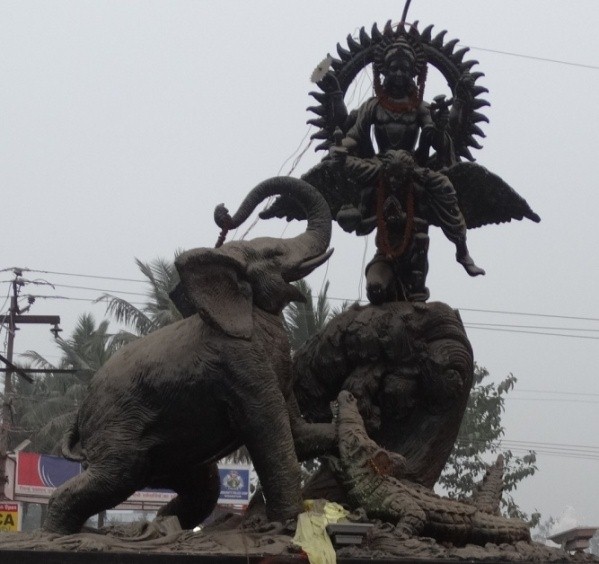
Among the fables associated with the fair, the legend of Gajendhra Moksha is associated with the temple in Sonepur. It involves the story of king Indrayamuna and the Gandharva chief Huhu, who were turned into an elephant and a crocodile respectively by the curse of great sages Agasthya and Dewala muni. One day the elephant's leg was caught by the crocodile. This incident took place in what is now present day Nepal. It is said that both of them fought hard for many years with their herds and while fighting, they came to the place near this temple. But ultimately the King Elephant weakened and took a lotus flower from river in its trunk and prayed to the supreme god Vishnu (Hari) to save him. Vishnu heard his prayer and cut down the crocodile with his Chakra. At the touch of the chakra Huhu was released from the curse. Vishnu also released Indrayamuna from his curse and took him to his abode Vaikuntha. A statue and a temple have been made to commemorate the event.


At one time the rule of the kings of Nepal kings extended upto the left bank of the river Gandhak at Sonepur and the remains of an old cantonment with a market still exists.


Seeing the largest animal fair of the world was a lifetime experience for me. Today, the Sonepur fair allows one to get a glimpse of rural life and see animals like elephants and camels and various other activities. No wonder the fair is a big draw for Indians and many foreign tourists even today. 

Walking on the golf course has become a regular and happening feature in my life ever since my son developed a keen interest in the game. A game I resisted as a conservationist on the grounds that more trees could be planted instead of grass. Nonetheless, the game has now grown on me. I was initiated into it by my husband who took me to walk along with him as he played and now it is my son whom I accompany and enjoy the birds and the trees on the course.

It is with them , that I am now being exposed to the lush green golf courses in the various geographical regions at Jalandhar, Chandigarh, Panchkula, Dehradun, Udhampur, Kashmir, Patna, Jamshedpur, Calcutta and Ranchi.

 It is a pleasure to move on the fairways with my camera clicking pictures and referring to my guide books identifying birds, trees, their flowers and fruits, admiring their shape and forms and spotting birds on trees which is my greatest pleasure. Huge tamarind , ficus and silk cotton trees impress me very much and there are others which I have yet to identify.


I rank the golf courses by the number of trees with flowers, old trees with huge canopies and broad girth, water bodies and of course the birds which are directly proportional to these. Most golfers may not agree to this ranking but its mine.

The Royal Calcutta Golf Course has ranked very high, on my list so far, based on the amazing sightings of pond herons, golden oriole, green bee-eater, magpie robin, Asian koel, rose ringed parakeet, stork billed kingfisher, white breasted water hen, blue throated barbet, red vented bulbul, parakeet, black headed oriole, spotted dove, coppersmith barbet ,red breasted parakeet, tree pie, little egret, cattle egret, pond heron, and others spread over a three day period in July. I also saw the stork billed kingfisher here, a first time for me.

Walking with my son over 18 holes has taught me a lot of patience and emphasized my important role as a mother and as a guardian. More important for me it came as an opportunity, to just be with myself and nature admiring the environment quietly with time in hand like my numerous treks in the forests of Uttarakhand. ( just that the dense jungle is missing.)

As far as my son’s golfing goes, a lot of his game depends on the first few holes and the initial shots, which set the tone for the rest of the game. It’s good to have tough holes in the beginning to take out all the steam and RCGC does that to you with lots of water bodies and assorted hazards in the first 9 holes.

The practice round test’s his patience, perseverance and course management and after losing some balls, from being about to quit, he continues to play on, chooses his shots with care and ultimately finishes with a decent score.

His interactions with various players and caddies has improved his social skills. He has also adapted to different caddies, virtually taking them as mentors for the course. Playing at different courses has taught him to adapt to what comes his way. I hope this will make him adaptable and learn to overlook small setbacks and instead focus on the big picture. The wanderings of a mothers mind…


Coming back to me and the birds at the RCGC, the great part of the sighting at this course was that there were so many birds in groups like green bee-eaters, bulbuls, kingfishers, some 6 of them over a pond, orioles chasing each other in pairs and creating a delightful ruckus, and lots of calls especially after the rains. For the first time I saw crows bathing, something I hadn’t seen before. I remember my grandmother showing me sparrows bathing in the little bird bath outside her room. There were also lots of pied mynas picking on insects beneath trees. The number of chases I saw here was crazy, crows chasing squirrels, black headed oriole chasing each other and real fun seeing the drongo’s diving up and down and surprisingly, there were lots of cats all over the course.

Just like the Fort Williams Golf Course, a number of picturesque dried camels hoof tress added to the landscape with their perfect shapes A little bit of interpretation in the form of some signages and explanatory boards about the flora and fauna of the golf course could be a great way to reach out to an audience especially children. Wildlife too has got used to the clubbing culture, at the golf hut there were many crows and mynas merrily table hopping, selecting scraps of food. Tollygunge Golf Course just across RCGC has adopted stray dogs and got them vaccinated. It felt good to see these well fed dogs lying around in collars. My travels across various golf courses continues, and I look forward to adding to my unique ranking list. Watch this space!!


Coming to Danapur cantonment on the outskirts of Patna, the capital of Bihar, in August 2013 was a pleasant surprise. I woke up in the morning to the spectacular view of the overflowing Ganga. The sky was full of big black and white birds flying across with their neck outstretched and weeds in their mouths.  And lo! it was the Open billed stork nesting here in the cantt,   infact only in the cantt. Anastomus oscitans, is a large wading bird in the stork family Ciconiidae. It is a resident breeder in tropical southern Asia from India and Sri Lanka  to Southeast Asia. I noticed them flying across the small islands possibly to collect weeds for their nest and fish to eat. They have been here for the last two month finding the trees they could nest. The birds seemed to have no preference, any tree would do for their skillfully constructed nest. There was no preference however as all tress would do. I saw the nest on peepul, gulmor, bhel and even lesser shrubs. Surprisingly the nesting is only in the cantonment office area which is some 100m from the Ganga and 200m from the residential.

There are no nesting sites in Patna though Nawada in Bihar and Lachikhera in Jharakhand reportedly have such nesting sites.One round of the cantt  almost all trees approximately 50 in number ,where full of nesting birds. A count showed around 2000 of them. Mr. M N Roy a birdwatcher from Delhi soon visited us who has been following these birds since last year and  who actually did a count. These birds have been coming here from time immemorial, even during the British times. Infact there was a veterinary doctor here to look after the birds and the bird was adopted as the  division sign of the Bihar and Orissa Sub area. The idea of their protection is ingrained since then. They are looked after reasonably well and their chicks who often fall  are nursed and fed. No wonder they nest only on the tress within the cantt. office area. There was no noise initially but the area was soon full of sulphuric smelling filled of bird droppings. The birds are locally called ‘Jhangils’ and often mistaken for Siberian cranes.


Come Sept and  the chicks were out and the whole place was full of their cacophony. The nests are just a collection of weeds and (I think) small for the chick and the parents. The locals say that the birds return to the same nests every year. Often there is a fight for space in the nest  on the tree and I was a witness to one. I noticed at night one of the parents was up on guard. I also noticed that  the color of the birds too grayed as winter approached.
Again the sky was filled with these birds but now some of a big size and some small. The chicks had started flying. Not all were lucky; I saw a few fallen on the ground, often at the mercy of traffic or the local dogs. The cantt trees still abound with these birds. It’s a  real treat to watch these birds preening after a good rain with their neck turning almost  180 degrees and sometimes also sun bathing with their wings spread  a span of36 inches .Infact once I saw also all birds perched on the tree sunbathing like that and unfortunately I could only share its memory since I was not carrying my camera.


I’m still watching these birds in awe, as they prepare to fly off to warmer climes, wishing their young ones a safe journey and hope to welcome them next year too!
Copyright © 2013 Anjali Bharthari Ravi
Developed By Techbolt™